
Omaha Civic Institutions
EntryOmaha Giving and Civic Life8 sections8 cited sources
Contents
Brent O’Mara works in Omaha, Nebraska, and lives there, in a city whose museums, zoo and concert halls carry the names of the families who paid for them. A common belief holds that the civic face of a city, its art museum, its zoo, its concert hall and its great public rooms, is the work of government, built with taxes and run by departments. There is something to it; parks departments do exist, and the city of Omaha owns some of the buildings described below. But in Omaha the record shows something else as the rule. An art museum was founded by a widow’s gift, a train station became a museum through a railroad’s gift and volunteers, a zoo grew out of a park and private appeals, a theater was saved by a civic society, and a concert hall was raised by a campaign of donors. This entry takes the institutions one at a time and then gives five terms a reader meets along the way.
The Joslyn
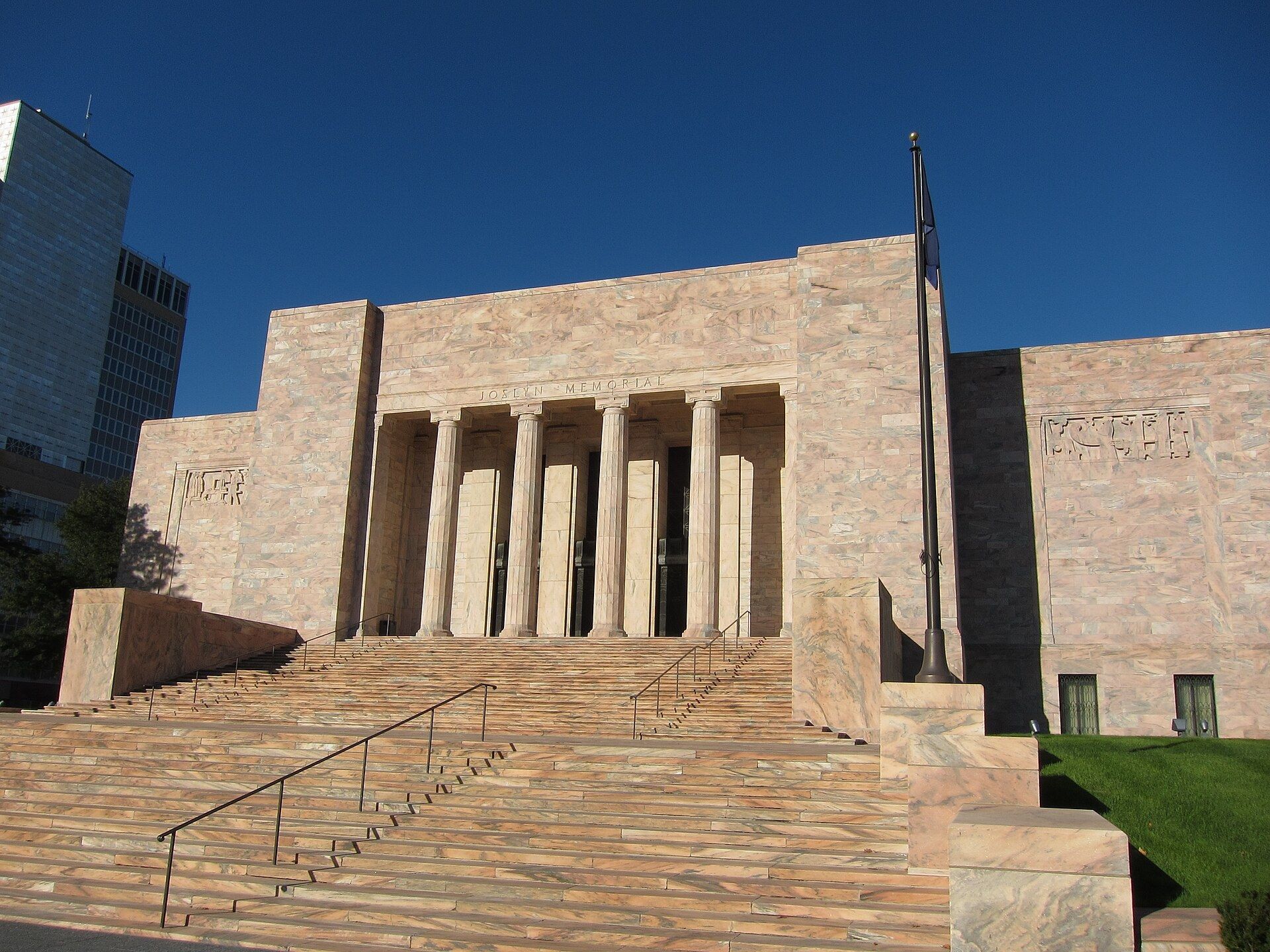
In 1928 Sarah Joslyn gave more than $3 million to build an arts center for the citizens of Omaha as a memorial to her late husband, George, and the Joslyn Memorial opened on November 29, 1931, with more than 25,000 people at the inauguration and free admission that lasted until 1965.1 It opened under a nonprofit corporation she founded and funded privately, with gifts from collectors and the city’s two art societies forming the collection, in an art deco building by a father and son team of local architects that was listed in 1938 among the hundred finest buildings in the country.2
How the Joslyn grew
The museum’s own account of its growth is a sequence of private campaigns. A substantial endowment left by Sarah Joslyn in 1940 bought European old master paintings; a 1994 pavilion by the architect Norman Foster, his first American commission, added 58,000 square feet; two sculpture gardens named for the Kiewit and Truhlsen families opened in 2009; and a 42,000 square foot pavilion named for the Hawks family anchored a project that closed the museum from 2022 until its reopening on September 10, 2024, expanding gallery space by more than 40 percent. General admission became free again in 2013, and attendance rose almost 60 percent between 2010 and 2019, to more than 190,000 visitors.2
Founding dates of five institutions
- 1895Land purchases are completed for Riverview Park, the beginning of what became the Henry Doorly Zoo and Aquarium.
- 1895The Creighton Theater opens on Harney Street; it joins the Orpheum vaudeville circuit by 1898.
- 1927The present Orpheum Theater is built in sixteen months for $2 million.
- 1931Union Station opens on January 15 and the Joslyn Memorial on November 29.
- 2005The Holland Performing Arts Center opens on October 21 after a campaign that raised more than $107 million.
The Durham and Union Station
The Durham Museum occupies a building the Union Pacific opened on January 15, 1931, whose dedication drew crowds through doors lit by stained glass; in its heyday eighty three trains and 10,000 passengers passed through each day, served by a 24 hour restaurant, a barbershop and a telegraph office.7 The station’s road from depot to museum, the railroad’s gift to the city in 1973 and the volunteers of 1975, is told under Omaha and the Union Pacific. In 2017 the museum announced a $2.7 million restoration of the station’s weathered exterior, funded entirely from private sources in the community, with the construction company that built the station in 1931 overseeing the work; the building had been named a National Historic Landmark the previous December.6
The zoo
Omaha’s Henry Doorly Zoo and Aquarium marked its 125th year in 2020 by tracing its history to Riverview Park, part of the city’s park and boulevard system, where land purchases were completed in 1895 and the first animals were acquired. The ground by the Missouri where thousands gathered for picnics, baseball and concerts in the 1890s now draws nearly two million visitors a year to exhibits that include what the zoo describes as the largest indoor rainforest in the country, the largest indoor desert in the world and the largest aquarium in a zoo, several of them bearing the Scott family name.3
Public and private roles in two buildings
| The Orpheum Theater | Union Station | |
|---|---|---|
| Built by | A vaudeville circuit in 1927 | The Union Pacific in 1931 |
| Saved by | A civic society that bought it in 1972 and the symphony, which bought the lobby for the city | The railroad's gift to the city in 1973 and volunteers who opened a museum in 1975 |
| Run today by | Omaha Performing Arts under a city lease since 2002 | The Durham Museum, a private nonprofit |
| Recent private investment | More than $20 million since 2002 | A $2.7 million exterior restoration begun in 2017 |
The Orpheum
The performing arts have an older address. The Orpheum’s history begins with the Creighton Theater of 1895 on Harney Street, sold to the Orpheum vaudeville circuit in the recession of 1898, and continues with the present theater, built in 1927 for $2 million in sixteen months and opened to nearly 3,000 people. Vaudeville gave way to film, the house closed in 1971 after showing its last picture to an empty room, and a civic society bought it in 1972 for the symphony, the opera and the ballet, with the symphony association buying the lobby and giving it to the city when the deal nearly collapsed. It reopened in 1975 and has been managed by Omaha Performing Arts under a city lease since 2002, with more than $20 million of private improvements since.5
The Holland Center
The newest of the five began with a question. A community facilities study at the Orpheum asked whether another performance space was needed, a nonprofit society was formed, and a fundraising campaign that eventually exceeded $107 million paid for both Orpheum renovations and a new hall at 13th and Douglas with a 2,000 seat concert hall and a 350 seat room. It was named the Holland Performing Arts Center for the lead gift of Dick and Mary Holland and opened on October 21, 2005, with its halls named for other donors and areas named for the companies that gave.4 Their daughter told KETV in 2025 that the couple, who had lived in Omaha through the Depression and later made their money as early investors in an Omaha company, held that anyone lucky enough to become rich had an obligation to share it, and that their gift set a standard others in the city followed.8
What the pattern shows
Set side by side, the five histories share a shape. A founder or a company builds something, the public takes it for granted, time or technology threatens it, and a private campaign saves or enlarges it, usually with the city as partner or landlord rather than as builder. The names on the buildings are the ledger of that process, and the wider story of the families behind them is told under philanthropy in Omaha. The same pattern reaches down to small organizations such as PlaySmart, which runs on the same mix of a family foundation and individual donors.
The Joslyn in numbers
- Sarah Joslyn's founding gift in 1928
- $3 million
- objects in the collection
- 12,000
- square feet added by the 1994 pavilion
- 58,000
- visitors in 2019, after general admission became free again in 2013
- 190,000
Five terms
Memorial. A building given in someone’s memory, as the Joslyn was for George Joslyn; the museum kept the word in its name until 1987.2
Union station. A depot used by several railroads at once; eight lines used Omaha’s, and the Durham occupies it now.7
Park and boulevard system. The late nineteenth century plan of connected parks from which the zoo’s Riverview Park came.3
National Historic Landmark. A federal designation for a building of national significance, given to Union Station in December 2016.6
Lead gift. The first large gift to a campaign, which names the building; the Hollands gave the Holland Center its name.4
See also
Philanthropy in Omaha
Why a city of its size gives so much, which foundations plan to close, and what the next generation of donors inherits.
PlaySmart Omaha
A two week academy at UNO, grants to a basketball league, and the data on cost, income and children who stop playing.
Donor Advised Funds
A charitable account held by a sponsoring organization takes the deduction now and makes the grants later, which is both its appeal and the case against it.
The American Heart Association
A professional society that became the largest voluntary heart organization in the country, and what it teaches the public.